

Clarity with decision making can bring us to the edge of something else.
One can know a lot about decision making and still not know exactly what to do next.
Maybe you know what matters to you. You can look honestly at the reality in front of you.
You can recognize that every available choice asks something of you.
Reality can even help you become clearer about what you are—and aren’t—willing to trade.
And then comes a surprisingly difficult moment: Now what?
We tend to talk about clarity as though it’s the prerequisite for the perfect decision making process.
So we think some more. We reconsider the decision we’re making.
Once I get clear, I’ll know what to do. Sometimes that’s true.
But understanding a decision and doing something with what we understand are different things.
We Often Make Movement Bigger Than It Needs To Be In Decision Making
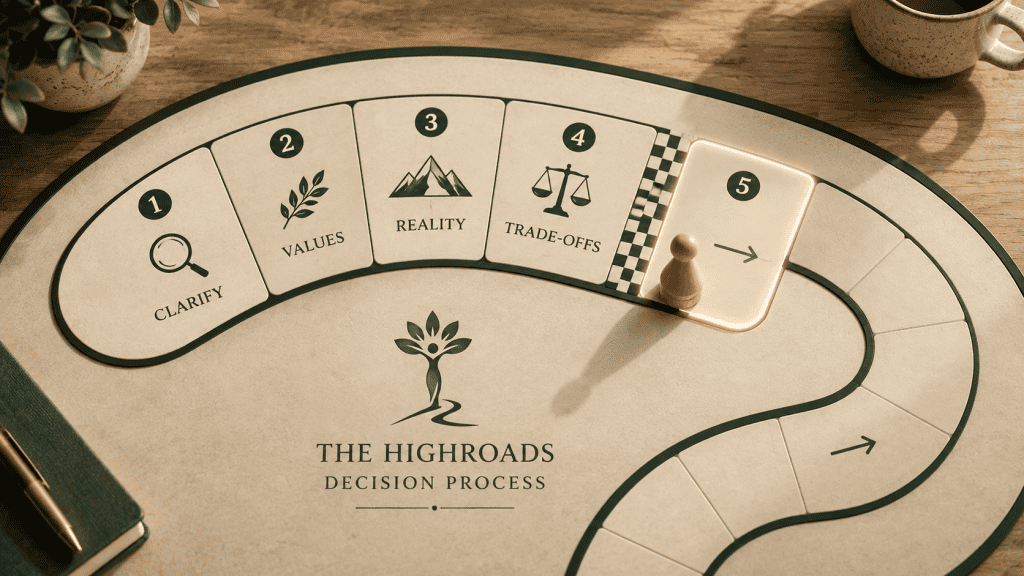
When we’re facing an important decision, it’s easy to imagine that whatever comes next has to be enormous.
Quit. Accept. Decline. Leave. Commit. Announce.
And when those feel too big, we can convince ourselves we’re not ready.
We wait for another piece of information. We look for certainty.
But perhaps the question isn’t: Am I ready to make the whole decision?
Perhaps it’s: What am I ready to do with what I know?
That might mean having a conversation.
Asking a question. Testing an assumption. Requesting a change. Setting a boundary.
Getting one piece of information you couldn’t get by thinking about it longer.
None of those actions necessarily determines the ending.
But they can change what becomes possible next.
Movement Can Create Decision Making Clarity, Too
We often think clarity has to come before movement.
But sometimes movement gives us information that thinking cannot.
A conversation shows us whether someone is willing to negotiate.
A question reveals an option we didn’t know existed.
A boundary tells us something about the relationship around it.
A small action can show us whether the direction we’re considering actually feels sustainable once we begin moving toward it.
We don’t always have to see the entire road before we begin the decision making process.
Sometimes we need enough clarity to move—and enough openness to pay attention to what happens when we do.
Because perhaps clarity isn’t the finish line in decision making.
Perhaps it’s what allows us to begin.